
Restoring Peatlands: Does It Offset Greenhouse Gas Emissions?
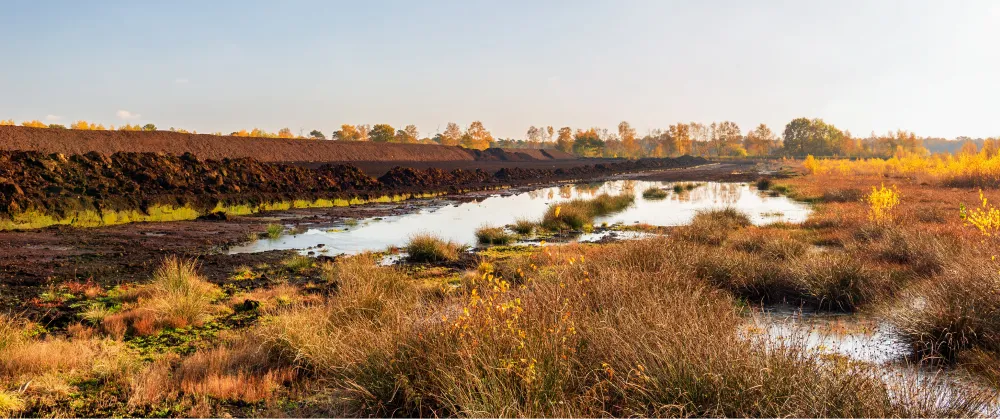
Peatlands are the UK’s largest carbon store, holding more carbon than the forests of the UK, France and Germany combined, despite covering a fraction of the land area. Yet over 80% of the UK’s peatland is currently damaged or degraded, mostly through drainage for agriculture, forestry or peat extraction. Once drained, peat stops storing carbon and starts releasing it, a slow reversal of thousands of years of accumulation. Restoring peatland landscapes has become a cornerstone of UK climate policy but many businesses are increasingly asking, does restoring peatland actually offset greenhouse gas emissions?
What peatland restoration involves
Restoration typically means rewetting: a process that involves blocking the drainage channels cut into the peat, raising the water table back towards the surface, and allowing the site to revegetate with peat-forming plants such as sphagnum moss. The aim is to recreate the waterlogged, low-oxygen conditions that stopped decomposition in the first place and allowed peat to form and store carbon over millennia.
What the evidence shows
Stopping the drainage-driven decomposition of peatlands is a legitimate, measurable climate benefit which prevents further emissions of carbon dioxide (CO₂) occurring. However, the trade-off is that rewetted peat introduces another emission into the bargain: methane.
A 2020 study published in Nature Communications modelled this trade-off directly, comparing the warming effect of CO₂ from drained peat against the warming effect of methane from rewetted peat. It found that, on balance, rewetting reduces overall climate warming, and that delaying rewetting to avoid short-term methane emissions increases long-term warming rather than reducing it.1
The caveat is timing. Rewetting a peatland does not switch it from source to sink overnight. As the water table rises, anaerobic conditions return, and this restarts methane production, a much more potent greenhouse gas than CO₂ over short timescales, even though it breaks down in the atmosphere far more quickly. Research tracking a rewetted German peatland over more than a decade found that emissions took thirteen to sixteen years to settle into the pattern that international default emission factors assume.2 In practice, this means a newly rewetted site can spend years as a smaller emitter, or even a modest methane source, before it reliably becomes a net carbon sink.
None of this undermines peatland restoration on the whole. Restoring peatland offsets emissions is a valid strategy, but this is not something that happens instantly or uniformly across every site. Soil type, prior land use, and how carefully the rewetting is managed all affect how quickly, and how fully, the benefit materialises.
UK policy and verification
The government’s England Peat Action Plan set out the ambition to bring peatland into restoration or sustainable management at scale, alongside a ban on horticultural peat sales and continued funding through environmental land management schemes.3 However, progress has been slower than intended. The Climate Change Committee’s 2025 progress report assessed peatland restoration as “slightly off track” against the rate needed to support the UK’s Net Zero pathway, alongside woodland creation and heat pump installations.4
For businesses looking to fund restoration as an offset, the relevant standard is the Peatland Code, a voluntary certification scheme developed by the International Union for Conservation of Nature (IUCN) UK Peatland Programme. It requires independent validation of a project’s expected carbon benefit, deducts an uncertainty buffer from the claimed savings, and sets aside a portion of credits in reserve to guard against non-permanence. Credits generated this way are registered on the UK Land Carbon Registry, giving buyers a way to check a project’s status before purchase.
What this means in practice
For an organisation weighing up peatland credits, the truth is that they represent a credible, UK-based, nature-based offset, but one still built on a slower and more variable carbon benefit than something like avoided fossil fuel combustion. They’re best treated as one part of a wider strategy that prioritises reducing emissions at source, with high-integrity offsetting reserved for the residual emissions that are genuinely difficult to eliminate.
How 2EA Can Help
If you’re assessing offsetting options as part of a wider carbon reduction strategy, 2EA can help you understand how nature-based credits fit alongside your operational emissions reduction targets. Get in touch to discuss your carbon management approach.
Sources
- Günther, A. et al. (2020) ‘Prompt rewetting of drained peatlands reduces climate warming despite methane emissions’, Nature Communications, 11, 1644. https://www.nature.com/articles/s41467-020-15499-z
- (2024) ‘Temporally dynamic carbon dioxide and methane emission factors for rewetted peatlands’, Communications Earth & Environment. https://www.nature.com/articles/s43247-024-01226-9
- Defra (2021) England Peat Action Plan. https://assets.publishing.service.gov.uk/media/6116353fe90e07054eb85d8b/england-peat-action-plan.pdf
- Climate Change Committee (2025) Progress in reducing emissions – 2025 report to Parliament. https://www.theccc.org.uk/publication/progress-in-reducing-emissions-2025-report-to-parliament/