
Street Lights – Sustainability & Energy Usage
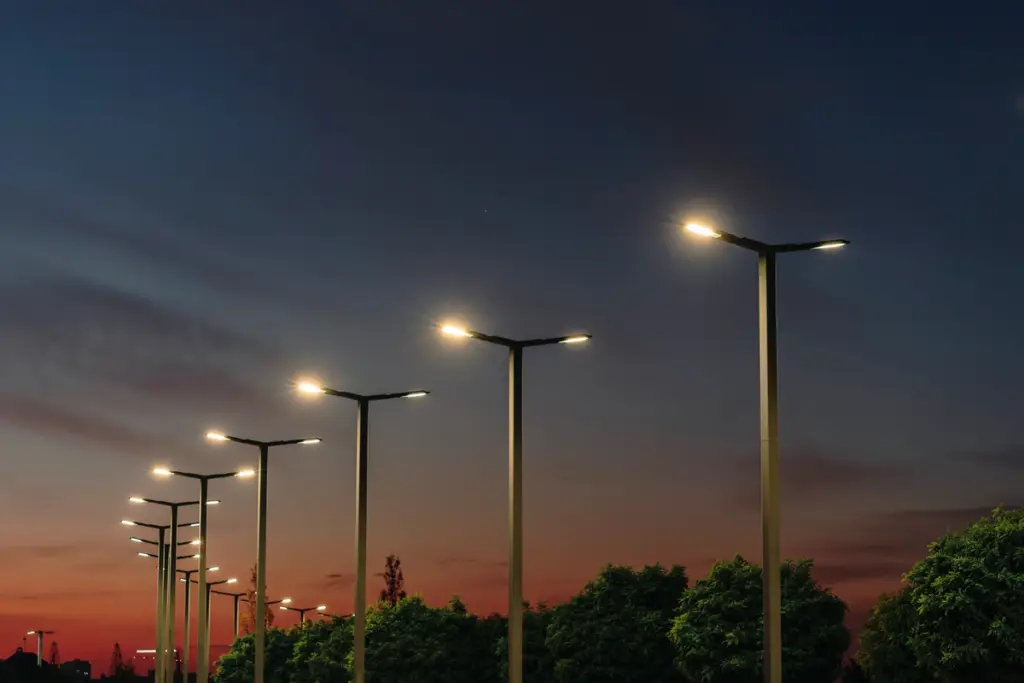
Street lighting is easy to take for granted, but its energy use is not. For many local authorities, the lights along their roads and footpaths are among the largest single items on the electricity bill and a significant part of their carbon footprint.
Over the past 15 years, councils have cut that footprint considerably, mainly by switching to LEDs and introducing smarter controls. The energy price rises from 2022 onwards added fresh urgency, and the conversation has widened to include dimming, part-night switch-offs and light pollution.
How much energy do street lights use?
The UK had around 7.1 million street lights in 2020, according to a survey commissioned by the UK Lighting & Technology Board.¹ Between 2010 and 2020, their combined energy use fell from roughly 2,620 GWh to 1,887 GWh a year, largely as a result of LED conversion.
At a local level, the figures are significant. Harrow Council has reported that street lighting accounts for 25% of its electricity consumption and 12% of its carbon emissions,² while Plymouth puts street lighting and road furniture at around a quarter of the City Council’s total emissions.³ Running costs have also risen sharply. Cornwall Council’s nightly street lighting energy cost increased from £5,274 in 2021 to £9,445 in 2023.⁴
The switch to LED
LED lanterns are the single biggest lever. Leeds City Council completed the conversion of more than 89,000 street lights in 2024 and expects to reduce street lighting energy use by around 62%, saving approximately £3.4 million a year at current prices.⁵ Lancashire County Council converted 152,000 lights, reducing annual street lighting emissions from 35,101 tonnes in 2009 to 5,101 tonnes by 2020/21.⁶
Not all of that reduction comes from the lanterns themselves. The carbon intensity of grid electricity has fallen considerably over the same period as coal has been phased out, so each kilowatt hour now carries less carbon.⁷ Even so, LEDs reduce the underlying demand, and that saving holds regardless of how the electricity is generated.
There is still some way to go. The 2020 survey found that around 3.9 million of the UK’s street lights were LED, and estimated that converting the remainder would cost around £755 million but deliver £6.8 billion in electricity savings and 5 million tonnes of emissions savings over 25 years.¹
Dimming, trimming and part-night lighting
Once lights are converted, control systems allow councils to go further. Common approaches include dimming during quieter hours, trimming (switching on slightly later and off slightly earlier) and part-night lighting, where some lights are switched off entirely in the early hours.
Leicestershire County Council dimmed most streetlights to 30% brightness between 8pm and 7am over an 18-month trial, saving more than £540,000.⁸ Coventry introduced citywide part-night lighting in 2024, and a police review found no evidence of crime increasing as a result.⁹ When the council’s energy price later fell from around 38p to 24p per kWh, it was able to switch lights back on overnight while still meeting its savings target.¹⁰ This is a reminder of how closely these decisions are tied to energy prices.
Part-night lighting remains the most contentious of these measures. Residents often raise concerns about safety, and councils typically exempt town centres, junctions and other higher-risk locations.
Beyond carbon: light pollution and biodiversity
Energy is not the only consideration. Artificial light at night affects wildlife, particularly insects, bats and birds, and groups such as CPRE and Buglife have highlighted its impact. Oxfordshire County Council has considered dark skies proposals that would reduce illumination for environmental as well as financial reasons.¹¹ Warmer colour temperatures, better-directed optics and lower light levels can address many of these concerns without leaving streets unlit.
Outlook
Street lighting shows how operational changes can deliver measurable carbon and cost savings. LED conversion is now standard practice, and the remaining gains lie in completing conversion programmes, making better use of controls and balancing energy savings against public safety and the environment.
The same principles apply well beyond the highway. Car parks, industrial sites, campuses and commercial premises all rely on external lighting, and many still run older, less efficient lamps on fixed schedules.
How 2EA Can Help
2EA helps organisations understand where their energy goes and how to reduce it. Whether lighting forms part of an ESOS assessment, SECR report or Carbon Reduction Plan, we can help you identify savings, quantify the carbon impact and build a clear plan for improvement. Get in touch to find out more.
Sources
- UK Lighting & Technology Board / Transportation Professional – Saving costs and carbon by investing in street lighting (January 2021): https://ukrlg.ciht.org.uk/media/12711/transpro_january2021_ukrlg.pdf
- Harrow Council – Street Lighting report: https://harrow.moderngov.co.uk/documents/s74482/Street%20Lighting.doc?CT=2
- Plymouth City Council – Roads and street furniture: https://www.plymouth.gov.uk/climateemergency/corporatecarbonreductionplan/roadsandstreetfurniture
- Cornwall Council – Street Lighting: https://www.cornwall.gov.uk/transport-parking-and-streets/roads-highways-and-pavements/streetlighting
- Leeds City Council – Leeds £22.5m LED lighting scheme completed (February 2024): https://news.leeds.gov.uk/news/led-ing-the-way-leeds-gbp-22-5m-led-lighting-scheme-completed
- Local Government Association – Lancashire County Council: Low Carbon Street Lighting: https://www.local.gov.uk/case-studies/lancashire-county-council-low-carbon-street-lighting
- Solihull Council – Streetlighting Report 2019: https://www.solihull.gov.uk/sites/default/files/Streetlighting-Report-2019.pdf
- Leicestershire County Council – Streetlight dimming trial delivers £540k savings: https://www.leicestershire.gov.uk/news/streetlight-dimming-trial-delivers-ps540k-savings
- Coventry City Council – Part-night Lighting update: https://edemocracy.coventry.gov.uk/documents/s62847/04%20-%20SB4%20Street%20Lights.pdf
- Coventry City Council – Briefing Note: Street Lighting (October 2025): https://edemocracy.coventry.gov.uk/documents/s65330/Briefing%20Note%20Street%20Lighting.pdf
- Oxfordshire County Council – Dark Skies: Street Lighting Illumination Proposals (November 2024): https://mycouncil.oxfordshire.gov.uk/documents/s73234/CMDDLC14112024%20-%20Dark%20Skies%20-%20Street%20Lighting%20Illumination%20Proposals.pdf