British Industrial Competitiveness Scheme (BICS)

The British Industrial Competitiveness Scheme (BICS) is a new government scheme which provides energy price support to businesses operating in frontier manufacturing sectors and foundational manufacturing industries, as defined by the government’s Industrial Strategy.
Businesses eligible for BICS will receive exemptions from the indirect costs associated with 3 existing electricity policy schemes:
- The Renewables Obligation (RO) and Feed-in Tariffs (FiT) which require electricity suppliers to make payments to support generation of electricity from renewable sources.
- The Capacity Market (CM) which requires electricity suppliers to make payments to ensure the UK has adequate electricity capacity.
The scheme opened for applications in October 2026. RO and FIT exemptions will begin from April 2027, and CM exemptions will begin from October 2027. The scheme will run until 2035, with a formal review scheduled for 2030
Funding Model
The BICS funding model partially replicates that of the Energy Intensive Industries support under the British Industry Supercharger. In both cases, electricity supplied to certified recipients is treated as “excluded” electricity and removed from the charging base for the RO, FiT, and CM. The total cost of each scheme is unchanged and is instead mutualised across the remaining, non-exempt supply. In practice:
- RO: The obligation level (ROCs per MWh) is set on estimated supply net of excluded electricity, and each supplier’s obligation applies only to its non-excluded supply
- FiT: Levelisation apportions scheme costs between suppliers by market share of GB supply, with excluded electricity deducted from each supplier’s declared supply
- CM: Supplier charges are levied on eligible or chargeable demand, with excluded volumes deducted at settlement
Because exempt volumes are removed from the denominator, the effective per-MWh rate on non-exempt supply rises. Each supplier’s share of scheme costs therefore reflects its market share of non-exempt demand, which suppliers recover through tariffs for non-exempt customers.
In the case of BICS, the government intends to offset the resulting cost increase for consumers who are not eligible for the scheme.
Two offsetting measures are in place, which combined comprise BICS funding:
- Energy System Savings: Changes to RO and FiT indexation, and from 2028 the removal of the Carbon Price Support, which result in reduced costs. Further detail is provided below.
- Exchequer-funded CfD Offset Mechanism: Exchequer funding will make up the difference between the energy system savings and the cost of BICS. This funding will be transferred to the Low-Carbon Contracts Company (LCCC) to facilitate a universal reduction in the CfD Interim Levy Rate (ILR). This reduction will generate savings for suppliers which we expect to be passed through to consumers, effectively offsetting the bill increase that would otherwise occur.
Impact of BICS and BICS funding measures on electricity bills for eligible businesses and ineligible consumers:
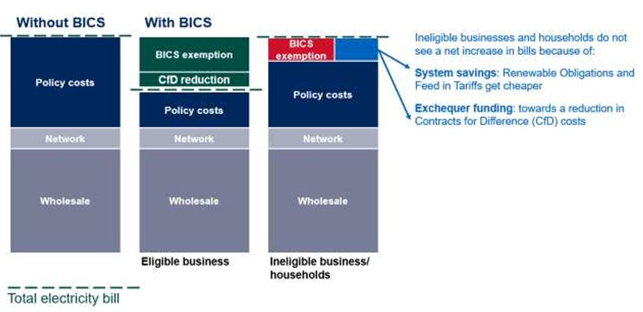
Note: The size of each component of the ‘electricity bill’ is not proportionate to its actual share of total costs. The figure is included for illustrative purposes only to demonstrate how the funding model works to offset the cost of BICS.