
Understanding El Niño and La Niña
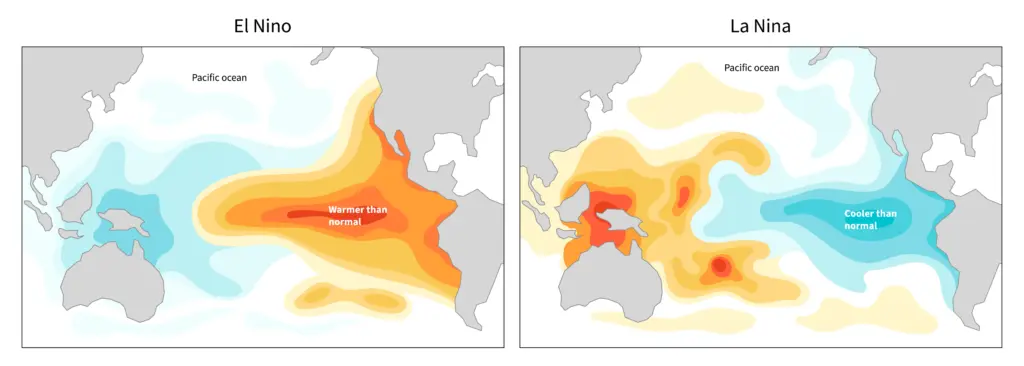
Relationships are complex things. Whether they’re between humans, animals or atmospheric systems, they rely on intricate and subtle interactions to maintain balance. In the case of El Niño and La Niña, that balance is heavily influenced by the trade winds, a term dating back centuries to the winds that helped sailing ships travel between Europe and the Americas.
Under normal conditions, these winds blow westward across the tropical Pacific Ocean, pushing warm surface water from South America towards Asia and Australia. As this warm water moves west, colder nutrient-rich water rises from the depths to replace it through a process known as upwelling.
El Niño, meaning “Little Boy” in Spanish, and La Niña, meaning “Little Girl”, are climate patterns that disrupt this normal cycle. Together they form part of the El Niño-Southern Oscillation (ENSO), a naturally occurring climate phenomenon that influences weather patterns around the world.
These events typically occur every two to seven years and can last for a year or more. Between these phases, the Pacific Ocean often returns to neutral conditions. While ENSO is a natural cycle, scientists closely monitor it because of its ability to influence temperatures, rainfall patterns and extreme weather across much of the globe.
El Niño
During an El Niño event, the trade winds weaken, allowing warm surface waters to move back eastwards towards the west coast of the Americas. This shift alters atmospheric circulation and changes weather patterns far beyond the Pacific Ocean.
The warmer waters tend to push the Pacific jet stream further south and east, bringing wetter conditions to parts of the southern United States and western South America. At the same time, regions such as Australia, Southeast Asia and parts of Africa often experience hotter and drier conditions, increasing the risk of drought and wildfires.
El Niño can also contribute to more tropical storms in parts of the Pacific and often leads to a temporary rise in global temperatures as additional heat is released from the ocean into the atmosphere.
La Niña
La Niña has the opposite effect. During a La Niña event, trade winds strengthen and push even more warm water towards Asia and Australia. This enhances upwelling along the west coast of the Americas, bringing colder water to the surface and cooling large areas of the eastern Pacific Ocean.
These cooler ocean temperatures influence weather patterns around the world. The southern United States often experiences drier conditions, while Canada and the Pacific Northwest can see increased rainfall and flooding. Australia and parts of Southeast Asia frequently experience wetter-than-average conditions.
La Niña is also associated with more active Atlantic hurricane seasons and can sometimes persist for multiple years, as demonstrated by the prolonged La Niña phase that occurred between 2020 and 2023.
Why Does ENSO Matter?
Although El Niño and La Niña begin in the Pacific Ocean, their impacts are felt worldwide. Changes in rainfall, temperature and storm activity can affect agriculture, water supplies, ecosystems and economies.
Strong ENSO events have been linked to crop failures, flooding, droughts, disruptions to fisheries and increases in food prices. In some cases, the economic impacts have reached hundreds of billions of pounds globally.
No two El Niño or La Niña events are exactly alike, which makes forecasting their impacts challenging. Scientists use satellites, ocean buoys and other monitoring systems to track changing conditions and improve predictions.
Why Scientists Are Watching Closely
Scientists continue to monitor Pacific Ocean temperatures and subsurface ocean conditions for signs of developing El Niño and La Niña events. In some years, unusually warm water several hundred metres below the surface can indicate that a stronger El Niño may develop, potentially increasing the likelihood of significant weather impacts around the world.
Conclusion
El Niño and La Niña are natural parts of Earth’s climate system, driven by changes in ocean temperatures and atmospheric circulation across the Pacific Ocean. While they occur irregularly, their influence extends across continents, shaping weather patterns and affecting millions of people around the world.
Understanding these climate cycles helps scientists, governments and businesses prepare for the challenges and opportunities they may bring.