
What Is London’s ULEZ? And How Does It Differ from the Congestion Charge?
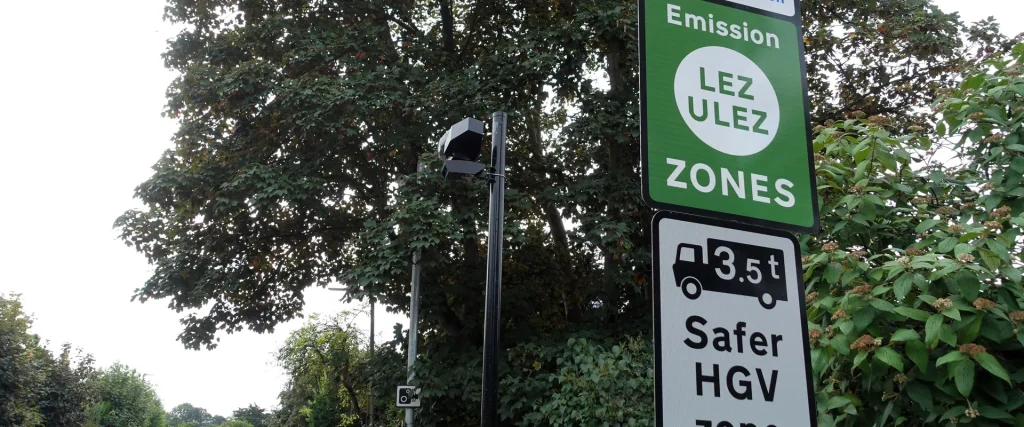
London’s Ultra Low Emission Zone (ULEZ) is one of the most talked-about pieces of environmental policy in the UK, and one of the most misunderstood. Many people confuse it with the Congestion Charge, or assume it’s the same thing as a “Clean Air Zone.” This first article in our series sets out what the ULEZ actually is, how it differs from London’s other charging schemes, and how it fits into the wider UK picture.
What is the ULEZ?
The ULEZ charges drivers of the most polluting vehicles a daily fee to drive within its boundary. Vehicles that do not meet the required emissions standards must pay £12.50 a day, 24 hours a day, every day except Christmas Day.1
How does this differ from the Congestion Charge and Clean Air Zones?
London operates the ULEZ alongside a separate, older scheme – the Congestion Charge – and the two are frequently confused. A vehicle can be liable for one, both, or neither, depending on where and when it is driven.
London’s scheme is also sometimes referred to as a “Clean Air Zone”, but this is the specific term for separate class-based charging schemes in cities such as Bath, Birmingham, Bristol and Portsmouth.2 London’s ULEZ operates under its own framework, though City Hall does informally describe it as the largest clean air zone of its kind in the world.1
| Congestion Charge | ULEZ | Clean Air Zones (CAZ) | |
| Introduced | February 2003 | April 2019 | From March 2021 (varies by city) |
| Purpose | Reduce traffic volume and congestion | Reduce vehicle emissions | Reduce vehicle emissions |
| Coverage | Central London only (c. 1.3 sq miles) | All of Greater London (since August 2023) | City centre areas only, varies by city |
| Operating hours | Mon–Fri 7am–6pm; weekends/bank holidays 12pm–6pm | 24 hours a day, every day except Christmas Day | Varies; typically 24 hours a day |
| Daily charge | £18 (from January 2026) | £12.50 | Varies by city and vehicle class, typically £8-£12.50 for cars where charged, up to £50-£100 for HGVs |
| Who pays | Almost all vehicles, regardless of emissions | Only vehicles that fail emissions standards | Only vehicles that fail emissions standards |
| Private cars affected? | Yes | Yes | Only in some cities; several CAZs (Bath, Bradford, Portsmouth, Sheffield, Newcastle/Gateshead) charge commercial vehicles only, not private cars |
Figures: Congestion Charge,3 ULEZ,1 Clean Air Zones.2
Because the Congestion Charge and ULEZ overlap in central London during weekday daytime hours, a driver of a non-compliant vehicle travelling into central London on a weekday could pay both charges in full – £18 plus £12.50, a total of £30.50 for a single day.
A compliant vehicle in the same journey pays only the Congestion Charge, since it is exempt from the ULEZ. Outside the Congestion Charge’s operating hours, or beyond its central London boundary, only the ULEZ can apply, as it covers the whole of Greater London around the clock.
How was it envisioned to work, and was London first?
The logic was straightforward: charge the most polluting vehicles enough to make switching to a cleaner vehicle, or another mode of transport, the sensible choice.
The idea was first announced in 2014 by then-Mayor Boris Johnson, in response to evidence that road transport, particularly diesel vehicles, was the single largest source of harmful nitrogen dioxide (NO2) in London. His successor, Sadiq Khan, launched the scheme on 8th April 2019, covering the same area as the existing Congestion Charge zone, before expanding it in stages, first to inner London in 2021, then across all 32 boroughs in August 2023 .4
London’s ULEZ was the UK’s first scheme of its kind, and in 2019, the world’s first 24-hour ultra-low emission zone. It was not, however, first to introduce a formal Clean Air Zone; that distinction belongs to Bath, whose Class C zone launched on 15 March 2021, two years after London’s ULEZ. Birmingham, Portsmouth, Bristol, Sheffield, Bradford and the Tyneside area followed over the next two years 2,4. Scotland has taken a different approach entirely, with Low Emission Zones in Glasgow, Edinburgh, Dundee and Aberdeen operating under separate legislation, with no option to pay a daily charge instead.4
In the next article in this series, we look at what six years of evidence tells us about the ULEZ’s impact, including newly published research on how it has affected children’s health.
Sources
- Mayor of London / London City Hall, “The Ultra Low Emission Zone (ULEZ) for London”: https://www.london.gov.uk/programmes-strategies/environment-and-climate-change/pollution-and-air-quality/ultra-low-emission-zone-ulez-london
- GOV.UK, “Clean Air Zones”: https://www.gov.uk/guidance/driving-in-a-clean-air-zone
- Transport for London, “Changes to the Congestion Charge Scheme” (notice, January 2026): https://tfl.gov.uk/cdn/static/cms/documents/02-26-tph-notice-changes-to-the-congestion-charge-scheme.pdf
- House of Commons Library, “Clean Air Zones, Low Emission Zones and the London ULEZ” (CBP-9816): https://commonslibrary.parliament.uk/research-briefings/cbp-9816/